
IACS UR E26 & E27 Explained: Cyber Resilience Is Now a Class Requirement for New Ships
Monthly Read · No. 1212 min readby Suji Kumar C
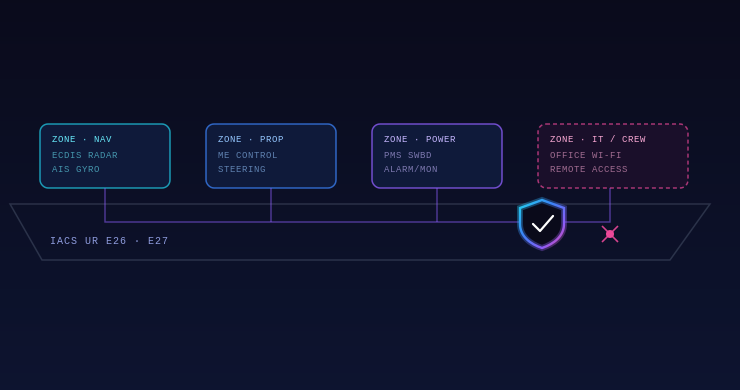
A modern ship is a floating network. Propulsion control, power management, ballast, navigation, alarm and monitoring systems all run on computers, and more of them talk to each other — and to shore — every year. That connectivity brings efficiency, and it brings risk. For years, the maritime industry treated cyber security as guidance. With IACS Unified Requirements E26 and E27, it became a condition of class for new ships.
What E26 and E27 Are
IACS — the International Association of Classification Societies — publishes Unified Requirements that every member society builds into its own rules. UR E26, Cyber resilience of ships, sets requirements at the level of the whole vessel. UR E27, Cyber resilience of on-board systems and equipment, sets requirements for the individual computer-based systems that equipment makers supply. Both were first published in 2022, completely revised in 2023, and the revised versions apply to ships contracted for construction on or after 1 July 2024.
They sit alongside IMO's requirement, in force since 2021, that ship operators address cyber risk in their Safety Management System. The difference is that E26 and E27 reach back into design and construction — the shipyard and the suppliers now carry part of the responsibility.
UR E26 — The Ship
Ship-level cyber resilience: which systems are in scope, how they are grouped into security zones, how traffic between zones is controlled, and how the ship detects, responds to and recovers from incidents.
UR E27 — The Equipment
System-level security capabilities for each computer-based system: access control, hardening, logging, secure configuration and the documentation to prove it.
Class — The Verification
Documents reviewed in design, tests witnessed at commissioning, and surveys through the ship's operational life.
Who Does What Across the Ship's Life
The rules divide responsibility by phase. During design and construction, the shipyard or an appointed system integrator owns the ship-level picture. At commissioning, the integrator proves the security measures work. In operation, responsibility passes to the ship owner, who must keep the ship in that secure state through every software update, equipment change and crew rotation.
Design & construction — shipyard / integrator
Vessel asset inventory, zones and conduit diagram, and a cyber security design description explaining how each requirement is met.
Equipment — suppliers (E27)
System asset inventory, topology diagrams, description of security capabilities, test procedures and security configuration guidelines.
Commissioning — integrator
A ship cyber resilience test procedure, executed and witnessed to show the security zones behave as designed.
Operation — ship owner
A ship cyber security and resilience programme covering change management, patching, access control, incident response and recovery, verified at surveys.
Security Zones and Conduits
The heart of E26 is network segmentation, borrowed from the industrial security standard IEC 62443. Systems with similar function and risk are grouped into security zones — for example propulsion and steering, power management, navigation, cargo control, and the ship's office IT. Communication between zones may only pass through defined conduits, and only the traffic described in the design is allowed to cross.
Anyone who has segmented a production network on land will recognise this immediately. It is the same thinking as separating a shipyard's CNC machines from its office network: a compromised laptop on the crew Wi-Fi must never be able to reach the propulsion controller. My earlier article on securing production networks covers the same principles from the factory side.
Identify
Know every computer-based system on board — what it is, what software it runs, where it connects. The asset inventory is the foundation for everything else.
Protect
Segment networks into zones, restrict remote access, control removable media, harden configurations and manage user accounts and passwords.
Detect
Monitor network traffic and logs so that abnormal activity is noticed, not discovered after a failure.
Respond & Recover
Have documented procedures, backups and the ability to fall back to manual or local control so essential functions continue during an incident.
E26 vs E27 at a Glance
| Topic | UR E26 (Ship) | UR E27 (System / Equipment) |
|---|---|---|
| Responsible party | Shipyard / system integrator, then owner | Equipment supplier |
| Scope | All in-scope computer-based systems on the vessel | Each individual computer-based system |
| Key design output | Zones and conduit diagram, design description | Topology, security capabilities, configuration guidelines |
| Verification | Ship-level tests at commissioning, surveys in service | System tests, approval by the classification society |
| Applies to | Ships contracted on or after 1 July 2024 | Systems installed on those ships |
Where Projects Struggle
The first wave of E26/E27 ships has now moved through design into delivery, and the difficult parts are rarely the firewalls. They are the paperwork, the interfaces between suppliers, and the handover to the owner.
Late Supplier Documents
The integrator cannot complete the zone design until every supplier delivers its E27 documentation. One late maker can hold up the whole ship-level submission.
Undocumented Connections
Remote-support modems, service laptops and convenience links added during commissioning break the approved zone design unless they are captured and controlled.
Weak Handover
The owner inherits a secure ship at delivery. Without trained crew, a patch process and change management, it will not stay secure for long.
- Maritime Cybersecurity
- IACS UR E26
- IACS UR E27
- OT Security
- IEC 62443
- Shipbuilding