
Shore Power for Ships: How High-Voltage Shore Connection (Cold Ironing) Works
Monthly Read · No. 1111 min readby Suji Kumar C
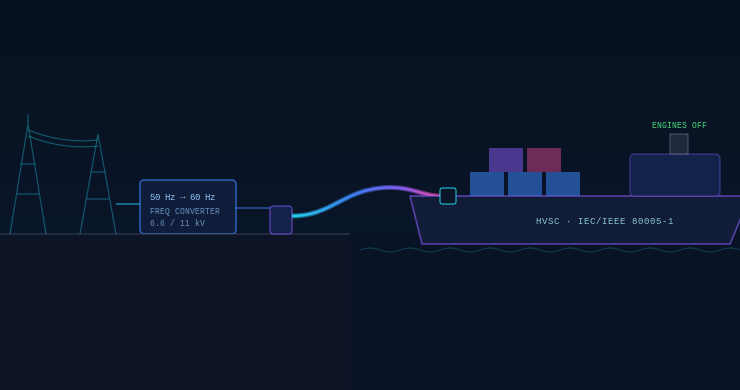
A ship does not switch off when it ties up. Pumps, cargo cranes, reefer containers, galleys, air conditioning, lighting and hotel loads keep running — on a large cruise ship, at the scale of a small town. Traditionally, auxiliary diesel generators supplied that power, burning fuel metres from the quay and the city behind it. Shore power, also called cold ironing or Onshore Power Supply (OPS), lets the ship plug into the land grid and shut its generators down.
What Shore Power Is
The idea is simple: bring a high-voltage cable from a substation on the quay to a connection point on the ship, transfer the ship's load onto it, and stop the engines. The engineering is not simple, because two independent power systems — a national grid and a ship's island network — have to be joined safely by people working on a busy quay, with different voltages, frequencies and earthing philosophies on each side.
Shore Side
Grid connection, step-down transformer, frequency converter where needed, an isolation transformer, protection switchgear and the quay outlet.
Interface
Flexible high-voltage cables, plugs and sockets, an earth conductor and a pilot or safety circuit that interlocks both ends.
Ship Side
A shore connection switchboard, protection and synchronising equipment, and often a cable management system on board.
IEC/IEEE 80005-1: The Common Language
For shore power to work, a ship from one country must be able to plug into a port in another. The international standard that makes this possible is IEC/IEEE 80005-1, Utility connections in port — High voltage shore connection (HVSC) systems. The current edition dates from 2019, with amendments published in 2022 and 2023. It defines the shore supply, the connection equipment, the ship-side requirements, the safety interlocks and the commissioning tests, with annexes for specific ship types.
The standard is aimed at ships with significant demand — it notes that HVSC is practical for ships needing around 1 MVA or more, or ships with a high-voltage main supply. Supply voltages are typically 6.6 kV or 11 kV AC. Smaller vessels use low-voltage shore connection under IEC/IEEE 80005-3.
Container ships
Reefer loads dominate. The standard annex defines the connection arrangement and plug configuration so a ship can connect at different container terminals.
Cruise ships
The largest demand at berth. The cruise annex specifies multiple parallel cables to carry the hotel load.
Ro-Ro & ferries
Short, frequent port stays make fast, repeatable connection procedures essential.
LNG carriers & vehicle carriers
Covered by their own annexes, including hazardous-area considerations and, for vehicle carriers, an 11 kV 60 Hz supply.
50 Hz vs 60 Hz: The Frequency Problem
Most ocean-going ships generate at 60 Hz, while much of the world's grid — including Europe and India — runs at 50 Hz. Motors, pumps and transformers on the ship are designed for 60 Hz; feeding them 50 Hz would reduce motor speeds, change pump output and overheat magnetic equipment. A shore power installation serving international ships therefore usually needs a static frequency converter — power electronics that take grid power in at 50 Hz and deliver a clean 60 Hz supply to the ship.
Frequency converters are a large part of a shore power project's cost and footprint. Ports serving a mix of ships often install a central converter station feeding several berths, sized for the berths most likely to be occupied at the same time.
Earthing, Isolation & Safety Interlocks
My earlier article on the IT earthing system explained why ships traditionally avoid a solidly earthed neutral. High-voltage shore connection has its own earthing design: the shore supply is galvanically isolated from the grid by a transformer, its neutral is earthed through a resistor that limits earth-fault current, and an earth conductor bonds the ship's hull to the shore earth before any power flows. This keeps fault currents low and predictable on both sides.
Interlocked Connection
High-voltage breakers cannot close until plugs are fully inserted, the earth connection is proven and the safety circuit between ship and shore is healthy.
Emergency Shutdown
An emergency stop on either side, or a broken safety loop — for example if the ship moves and strains the cable — trips the supply on both sides.
Load Transfer
The ship either briefly blacks out and restarts on shore power, or synchronises its generators with the shore supply and transfers load without interruption.
Commissioning & Periodic Tests
Each ship–berth combination is tested before first use, and the system is re-verified at intervals so interlocks are proven to work, not assumed.
Regulation: The EU 2030 Mandate
Shore power is moving from good practice to obligation. Under the EU's FuelEU Maritime regulation, from 1 January 2030 container ships and passenger ships above 5,000 gross tonnage that stay at berth for more than two hours in the main EU (TEN-T) ports must connect to shore power for their electrical demand, or use an approved zero-emission alternative. On the supply side, the Alternative Fuels Infrastructure Regulation (AFIR) requires those ports to provide shore power for a large share of calls by these ships by the end of 2029. Limited exemptions apply, such as unscheduled calls for safety reasons or an incompatible or unavailable connection.
| Aspect | Ship Owner | Port / Terminal |
|---|---|---|
| Obligation | Connect and use shore power at qualifying berths from 2030 | Provide shore power at qualifying TEN-T ports by end of 2029 |
| Engineering | Fit and certify a shore connection switchboard and interface | Grid capacity, frequency conversion, quay outlets and cable handling |
| Standard | IEC/IEEE 80005-1 compatible connection | IEC/IEEE 80005-1 compatible supply |
| Commercial | Electricity tariff vs fuel cost at berth | Investment recovery and grid connection charges |
For shipyards this means more newbuilds and retrofits specify a shore connection from day one, with the switchboard space, cable entry, protection and synchronising logic designed in rather than squeezed in later.
- Shore Power
- HVSC
- IEC/IEEE 80005-1
- FuelEU Maritime
- Marine Electrical
- Decarbonisation